Drew Schwarz · 17 September 2026
Global Trade Shifts Prompt Metal Suppliers to Rethink Sourcing Networks Beyond Asia
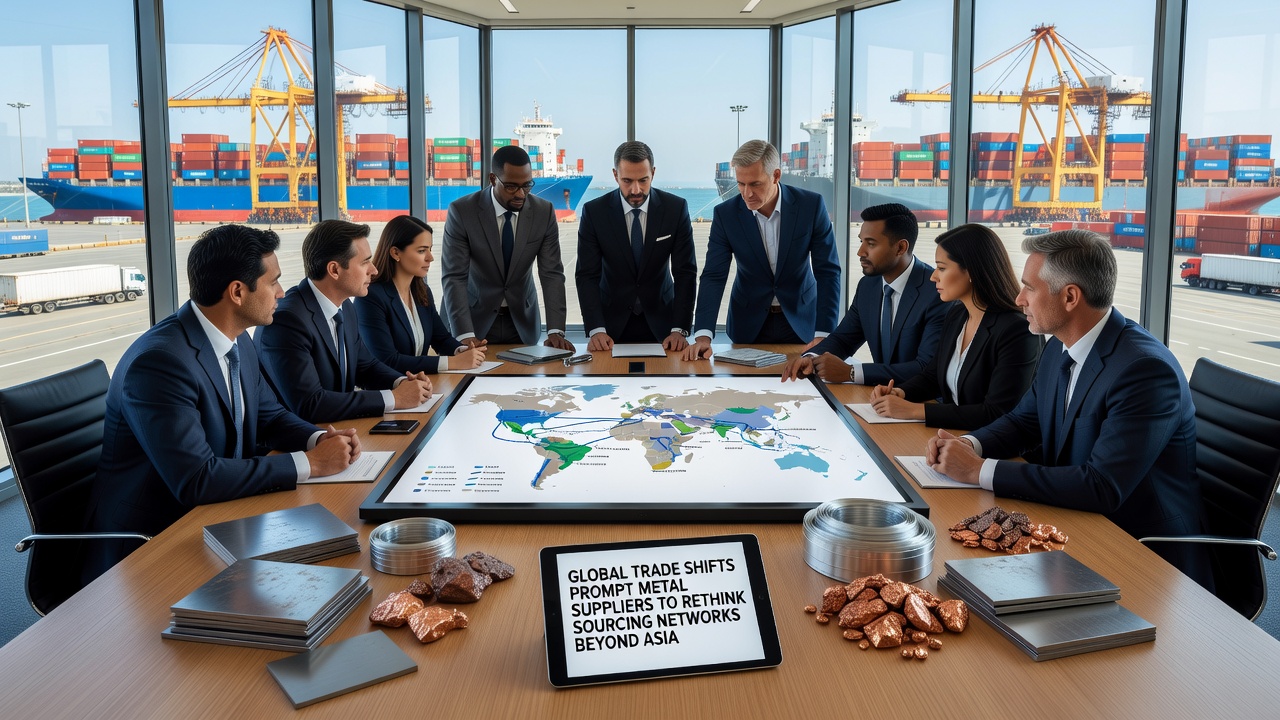
Global trade dynamics continue to reshape how metal suppliers organize their procurement operations, with many companies moving away from long-standing concentrations in Asia toward more distributed networks across multiple continents. Data from international monitoring bodies shows that tariff adjustments, shipping disruptions, and evolving regulatory frameworks have accelerated these adjustments since the early 2020s, prompting procurement teams to evaluate suppliers in Latin America, Eastern Europe, and parts of Africa.
Key Drivers Behind the Network Reconfiguration
Trade policy changes remain central to the shift, as governments in several major economies have introduced or expanded duties on steel, aluminum, and specialty alloys originating from specific Asian markets. According to figures released by the U.S. International Trade Commission, cumulative tariff impacts have altered cost structures enough that buyers now compare landed prices from alternative regions on a more systematic basis. Shipping reliability issues, including port congestion and container shortages that peaked in 2021-2022 and recurred in later years, have further encouraged diversification.
Meanwhile, environmental and labor standards in destination markets have tightened, requiring suppliers to demonstrate compliance documentation that some Asian facilities have found more difficult to maintain at scale. Observers note that these combined pressures create incentives for companies to develop secondary and tertiary sourcing options rather than relying on single-region concentrations.
Emerging Sourcing Regions and Their Capacity
Metal buyers have increased volumes from Mexico and Brazil, where proximity to North American and European end markets reduces transit times and exposure to certain geopolitical risks. Production capacity in these locations has grown steadily, supported by investments in electric arc furnaces and downstream processing facilities. Eastern European countries such as Poland and Romania have also expanded output, leveraging existing industrial infrastructure and access to EU markets.

African nations including South Africa and Morocco have seen incremental interest, particularly for aluminum and copper products, although infrastructure constraints continue to limit rapid scaling. Research compiled by the OECD trade directorate indicates that non-Asian sourcing shares for certain base metals rose between 2023 and 2025, with further acceleration projected through 2026.
Operational Adjustments Suppliers Are Making
Companies adapting to these conditions have invested in digital tracking systems that allow real-time visibility across multiple supplier tiers. Inventory strategies have shifted toward holding slightly larger buffer stocks at regional hubs to offset longer qualification cycles for new sources. Quality assurance protocols now incorporate more frequent third-party audits, especially when onboarding facilities with less established track records.
By September 2026, several major metal distributors expect to complete qualification programs for at least three additional non-Asian suppliers each, according to industry association surveys. Contract structures have evolved as well, with more agreements including flexible volume clauses and currency adjustment mechanisms to manage volatility arising from dispersed supply bases.
Challenges That Remain
Despite the momentum, logistical and technical hurdles persist. Rail and port capacity in some alternative regions lags behind established Asian corridors, while technical specifications for high-grade alloys sometimes require additional processing steps that increase lead times. Workforce skill gaps in newer production centers also necessitate training investments that can delay full ramp-up.
Those managing complex supply chains report that coordination costs rise when the number of active supplier regions increases, requiring enhanced enterprise resource planning integration and more frequent cross-functional reviews. Yet many firms view these added layers as necessary trade-offs for improved resilience.
Conclusion
Metal suppliers continue to expand their geographic footprints in response to sustained trade policy and logistics pressures, building sourcing networks that span multiple continents rather than concentrating within traditional Asian centers. Available trade statistics and capacity reports show measurable movement toward Latin American, Eastern European, and select African producers, accompanied by operational changes in inventory management, compliance verification, and contract design. As these networks mature through 2026 and beyond, the sector's sourcing patterns will reflect a broader distribution of risk and opportunity across regions.